
Google Ads Monthly Budget Planning: Separating Ad Spend, Management, Landing Pages, and Tracking
Separate your Google Ads monthly budget across five cost layers, calculate acquisition limits from gross margin, and verify pages and tracking before scaling.
Business owners planning a Google Ads monthly budget often face a confusing gap when comparing agency proposals. Two quotes can target the same Indonesian buyers and still show very different monthly totals. Usually, the lower quote is omitting the landing page work, creative production, or conversion tracking needed to turn paid clicks into qualified enquiries.
Treating media spend as your entire acquisition cost distorts decisions. Either you starve the auction, or you fund Google Search clicks that bounce on a slow brochure page with broken tracking.
Below, we separate the five cost components of a working Google Ads program, map budgets backward from sales economics, and show when to fix pages or tracking before scaling spend.
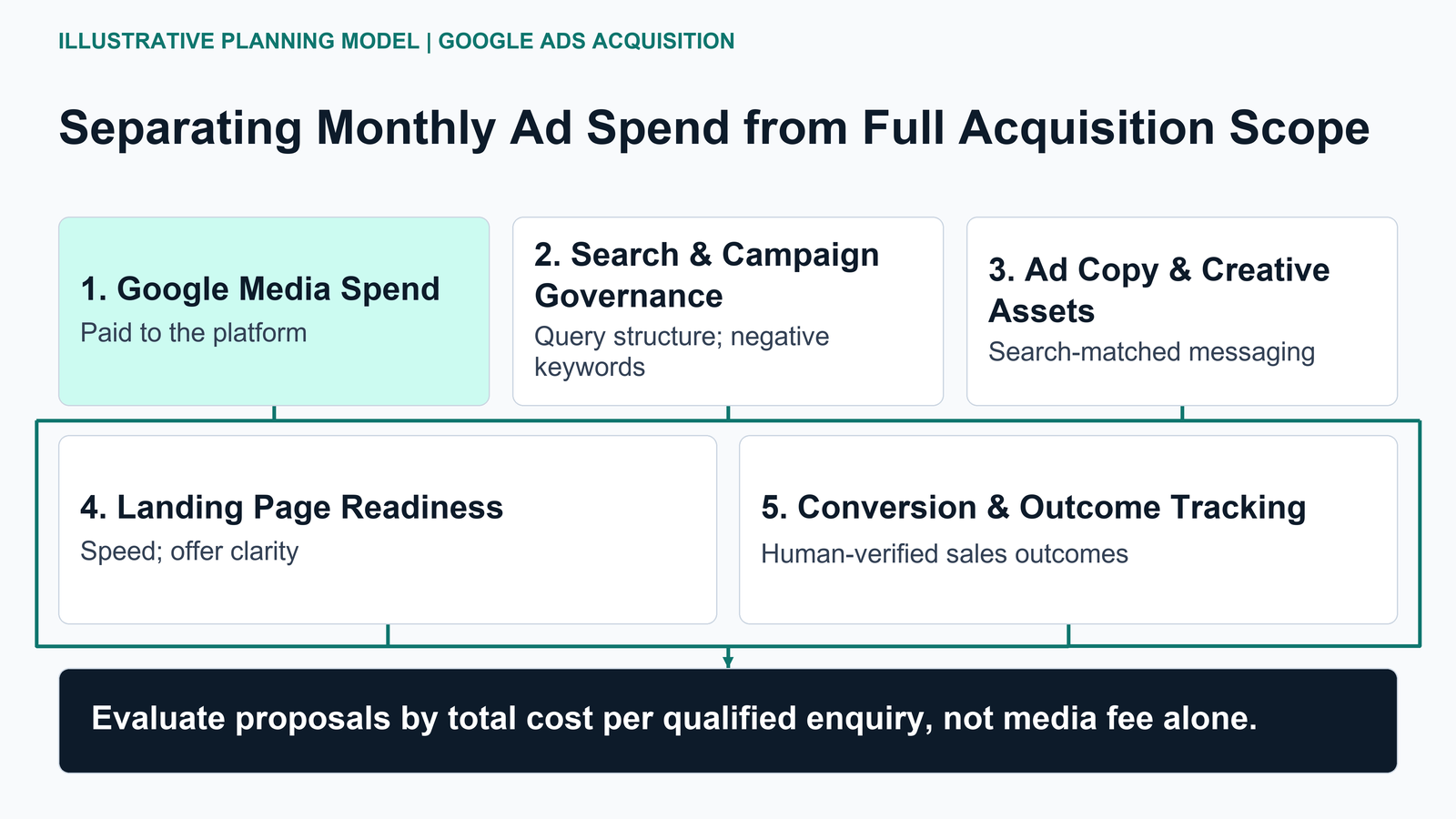
Direct answer: A complete Google Ads monthly budget separates five cost layers: auction media spend billed by Google, campaign and search term governance, ad creative assets, landing page or catalogue readiness, and verified conversion measurement. Calculate your monthly budget ceiling backward from target closed sales, sales close rate, and gross margin before scaling spend.
Five Cost Components in a Google Ads Monthly Budget
A complete Google Ads monthly budget covers five distinct cost layers: platform media spend paid to Google, campaign management and search term governance, ad creative assets, landing page or catalogue readiness, and conversion measurement. Official Google Ads budget documentation (2026) regulates auction media delivery only, excluding agency retainers, taxes, and destination page work.
Bundling all five items into one opaque invoice hides how much money enters the auction versus how much funds operator work. Separate them before comparing quotes:
1. Platform media spend. Working auction spend billed by Google for Search, Shopping, YouTube, or Display interactions. Daily spend can fluctuate within Google's 30.4-day monthly charging limit, and none of it pays for copywriting, page builds, or tag setup.
2. Campaign management and search term governance. Ongoing operator scope covering campaign segmentation, bid rules, negative keyword pruning, search term audits, geo-filtering, and pacing. Without search term governance, broad queries and research clicks drain daily spend before commercial buyers see your ads.
3. Ad assets and creative adaptation. Responsive Search Ad copy, sitelinks, callouts, and image extensions, plus visual and video cuts if running Performance Max or YouTube. Overseas brands planning Indonesia market entry marketing also need localized search phrasing rather than literal copy translations.
4. Landing page or catalogue readiness. B2B and service buyers need fast mobile pages that answer scope, specification, and trust questions clearly. E-commerce stores need clean Merchant Center feeds, accurate stock and pricing, and low-friction checkout.
5. Conversion and outcome measurement setup. Tag configuration in Google Tag Manager, separating soft clicks from real enquiries, deduplicating transaction IDs, and reconciling CRM or order outcomes. See how these layers fit together in our guide to marketing engineering that connects ads, landing pages, and sales signals.
Agency Proposal Comparison Matrix
Lay competing agency proposals side by side against the five rows below. Any blank row still carries a real cost in internal staff hours or wasted clicks.
Scroll sideways to see every column.
| Component | Scope Included | Payee and Owner | Proposal Red Flag | Deliverable to Verify |
|---|---|---|---|---|
| Platform Media Spend | Search, Shopping, Video, or Display auction delivery | Paid to Google; client owns ad account | Media and fee bundled with no Google statement | Direct Google billing access and statements |
| Campaign Governance | Structure, bid rules, negatives, search term audits, pacing | Paid to agency/operator; history stays in client account | Launch-only setup without ongoing search term cleanup | Search term audit cadence and negative lists |
| Ad Assets and Creative | Search copy, extensions, PMax or video creative cuts | Paid to agency/creative team; files stay with client | PMax proposed with zero visual or video production scope | Intent-mapped copy and creative matrix |
| Landing Page or Catalogue | Dedicated page UX, mobile speed, Merchant Center feed | Paid as web/feed scope on client domain | All ad groups routed to a generic homepage | Message-matched page or validated product feed |
| Conversion Measurement | GTM tags, event rules, CRM or order reconciliation | Paid as setup/QA scope; client owns GTM and GA4 | Every button tap counted as a primary conversion | Event map separating micro-clicks from leads |
Platform Billing, Taxes, and Account Ownership
Under Google Ads Indonesia billing terms, statutory Value Added Tax (PPN) applies to platform spend based on billing country and tax status, and agency pass-through billing can add withholding tax considerations. Confirm exact tax treatment with your finance advisor and require raw Google billing statements. Make sure your business holds admin ownership of Google Ads, GA4, Tag Manager, and Merchant Center from day one so historical search term and conversion data remain yours.
Backward Budget Planning from Sales Economics
Starting budget planning from competitor spend or generic click-price averages is a trap. Competitor budgets hide differences in gross margin, repeat orders, and sales capacity, while auction prices shift constantly with competition and page relevance.
Calculate your ceiling backward from your own unit economics:
- Target closed sales: Monthly orders or contracts expected from paid search.
- Sales close rate: Share of qualified enquiries your team actually closes.
- Required qualified enquiries: Target Sales / Sales Close Rate.
- Allowable cost per qualified enquiry: Maximum total acquisition cost per qualified enquiry that preserves target gross margin.
Always anchor this math in gross profit rather than surface revenue multiples; read our breakdown on understanding ROAS beyond the platform number for the full margin check.
Illustrative Monthly Budget Simulation
The example below is an illustrative planning simulation using hypothetical inputs, not a client result, a Lithe Agency rate card, or a market benchmark.
Suppose a B2B distributor targets 4 closed purchase orders per month from Google Search. Sales logs show that 1 in 5 specification-matched quotes closes (20% close rate), meaning the team needs 4 / 0.20 = 20 qualified enquiries monthly. If unit gross margin lets finance allocate at most IDR X per closed order for acquisition, 0.20 * IDR X becomes the maximum allowable total cost per qualified enquiry across media and operations. This formula never promises Google will hit that cost; an initial test budget exists to check whether live auction clicks and page conversion rates stay inside your ceiling.
Diagnostic Signals Before Scaling Monthly Ad Spend
Raising media spend works only when your destination page and conversion signals are already sound. If your current setup leaks high-intent visitors or feeds noisy conversion events back into Google's bidding models, doubling your monthly ad budget simply buys waste twice as fast. Before increasing spend on an underperforming page, check our diagnostic breakdown on why your landing page converts at 1 percent.
Unverified Click-to-WhatsApp Events
Service businesses and B2B suppliers in Indonesia rely heavily on WhatsApp click-to-chat buttons. Setting a contact_click button tap as your primary Google Ads conversion only confirms that someone opened WhatsApp, not that a message was sent or met your buyer criteria. Optimizing Smart Bidding on raw taps pushes spend toward accidental clicks and out-of-scope enquiries.
When engagements require visibility past the button click, Lithe coordinates with our AI implementation partner Agentik AI, whose WhatsApp inquiry-stage tracker WAtcher classifies downstream chat stages under agreed qualification rules. Feeding offline stages back into Google Ads still requires separate verification of click identifiers, consent, and import settings.
Disconnected Platform and Sales Records
Hold media scaling whenever ad dashboards and sales ledgers disagree. Two recurring failures drive this conflict:
- Raw form-submit optimization: Smart Bidding weights spam entries and real B2B buyers equally until qualified offline outcomes become the primary goal.
- Unreconciled checkout revenue: Platform conversion totals diverge from Google Analytics or backend orders due to duplicate tags, attribution windows, or modeled conversions.
Audit tag paths, deduplicate order IDs, and agree on one verified sales record before adding media budget.
Questions for Comparing Google Ads Agency Proposals
Ask every shortlisted agency four direct questions before signing:
- How is total monthly spend split? Separate Google media spend, taxes, management, creatives, landing pages, and tracking.
- Which primary event drives bidding? Require verified enquiries or deduplicated orders rather than page views or button taps.
- Who fixes low landing page conversion? Clarify whether destination page UX and speed are inside or outside the scope.
- Who holds admin ownership? Keep admin control of Google Ads, GA4, and Tag Manager under your company.
Frequently Asked Questions
Q: How should we set up WhatsApp conversion tracking in Google Ads without overcounting leads?
Keep website WhatsApp button taps as a secondary diagnostic metric rather than a primary bidding goal. Reconcile actual sent chats or qualified inquiry stages from your CRM or WhatsApp log, subject to consent and identifier matching, before judging campaign cost efficiency.
Q: Is there a fixed minimum Google Ads monthly budget in Indonesia?
Google sets no universal monthly minimum because auction click costs depend on industry competition, geography, and keyword intent. Size your initial validation budget around your sales team's enquiry capacity and the gross margin you can allocate during testing.
Q: Should agency fees follow a percentage of ad spend or a fixed scope retainer?
Judge any fee structure by the concrete operational deliverables included. Modest initial media budgets often still require substantial upfront work on search term governance, landing page alignment, and clean conversion setup before spend can scale safely.
Q: Do we always need a new landing page before launching Google Ads?
If paid clicks currently land on a slow, generic homepage with weak message match, fix or build a focused landing page before scaling spend. E-commerce stores with fast mobile checkout and clean product feeds can route Shopping traffic directly to relevant catalogue URLs.
Q: Why do Google Ads conversions differ from our internal sales spreadsheet?
Google Ads logs conversions by ad interaction date and attribution rules, while sales teams record leads or payments when deals close. Duplicate tags and unqualified submissions also create gaps, so budget reviews should always reconcile ad reports against CRM or order records.
Planning Your Google Ads Scope with Lithe Agency
Structuring a Google Ads monthly budget works best when media management, destination pages, and conversion definitions are reviewed as one connected commercial system. If you are weighing search acquisition for B2B enquiries or catalogue sales, explore how our team handles Google Ads campaign management or review our regional support for Google Ads services in Surabaya. When your current site needs stronger message match and cleaner enquiry capture before scaling paid traffic, see our landing page design and development scope so you can align page readiness with your target unit economics.
Disclaimer
This article is provided for educational budget-planning and commercial evaluation purposes only. Any formulas and illustrative simulations shown above use hypothetical planning inputs and do not represent a Lithe Agency price list, a competitor fee benchmark, tax or legal advice, or a promise of specific CPC, CPL, ROAS, or enquiry volume. Actual Google Ads auction costs, conversion rates, and statutory taxes depend on live market competition, account history, landing page quality, and official Google billing terms.
Related Resources
Marketing Engineering for Business: Connecting Ads, Landing Pages, and Sales Signals
Connect ad campaigns, landing page events, and sales qualification logs into one measurement chain so automated bidding optimizes for real buyers.
Building a Website and WhatsApp Sales Channel Alongside Marketplaces
Build a direct website and opted-in WhatsApp channel alongside your marketplace stores by comparing full selling costs, platform rules, and team capacity.
Understanding ROAS: Beyond the Number
Return on ad spend is more than a dashboard metric. Learn how to interpret ROAS in context: what it reveals about funnel health, creative performance, and budget allocation.