
Marketing Engineering for Business: Connecting Ads, Landing Pages, and Sales Signals
Connect ad campaigns, landing page events, and sales qualification logs into one measurement chain so automated bidding optimizes for real buyers.
Mid-sized ad budgets rarely leak because a media buyer clicked the wrong toggle inside Ads Manager. They leak in the handoff between platforms, pages, and sales desks. Meta or Google reports steady conversions at an acceptable cost per result, yet the commercial team sees dead phone numbers, silent WhatsApp threads, or backend order totals that look nothing like the ad account.
That disconnect explains why marketing engineering now comes up among founders, directors, and marketing leads. Search the phrase online and most pages cover job descriptions, salary threads, academic textbooks, or DIY outbound tool stacks. None of those help an operating business decide whether to scale next month's media spend.
Applied to paid acquisition, the discipline solves a concrete commercial problem: making sure the conversion events your campaigns optimize for match how customers actually buy from you. When ad platforms, landing pages, and sales logs speak different languages, automated bidding trains itself on noise.
Direct answer: Marketing engineering for paid acquisition connects ad campaigns, landing pages or catalogs, tracking events, and sales qualification logs into one measurement chain. Instead of training automated bidding on raw clicks or unvetted form fills, align conversion goals with verified commercial stages before scaling monthly media spend.
Marketing Engineering for Paid-Media Advertisers: An Operational Definition
For businesses running paid media, marketing engineering is the operational practice of connecting ad campaigns, landing pages or product catalogs, tracking events, and sales qualification records into one reliable measurement chain. Rather than buying extra outbound software, it aligns technical event definitions with actual commercial outcomes before scaling ad spend.
Terminology in this space gets tangled, so separating three neighboring uses helps clarify scope. University courses use marketing engineering for econometric decision-science models. B2B SaaS teams talk about go-to-market (GTM) engineering to describe prospect scraping, CRM enrichment, and automated cold outbound; note that GTM there means go-to-market rather than Google Tag Manager. Software product teams hire growth engineers to code onboarding flows inside an app.
An advertiser funding Meta Ads or Google Search needs a practical Paid-Media version instead of a new department. In Lithe Agency's practice, that chain connects six steps: creative hypothesis, ad delivery, landing page or catalog interaction, instrumented event capture, qualified inquiry tracking, and commercial budget review.
Three Places Where Ad Dashboards Drift from Sales Reality
Broken measurement rarely triggers an error banner. Pixels still fire and dashboards still paint green arrows. The trouble surfaces only when leadership compares ad reports against actual inquiries and cash collected. Across service brands, lead-generation accounts, and multi-channel retailers, three breakdown patterns recur.
Take a clinic or local service advertiser where buyers expect to ask questions on WhatsApp before booking. Removing the chat button to force web forms causes an immediate drop in inquiries. Yet tracking button taps on the page only proves WhatsApp opened on the phone. Click counts never show who sent a message or scheduled a visit, and script workarounds built to pass click IDs (GCLID) into chat tools often break when templates change.
A second breakdown hits Google Search operators keeping Submit Lead Form as their primary conversion goal under automated bidding. Every submission carries equal weight: spam, wrong numbers, and serious buyers all count as one win. Over time, bidding chases cheap form fills while sales reps call dead contacts. For tactical paid-social filtering, see improving Meta Ads lead quality; here we address signal architecture.
A third conflict stalls multi-channel e-commerce teams when an ad platform reports far higher purchase revenue than web analytics or checkout logs. Rather than assuming agency fraud or a broken receipt tag immediately, treat that gap as a structured investigation signal across attribution windows, statistical modeling for unconsented browsers, and channel overlap, as detailed in understanding ROAS beyond the platform number.
Three Measurement Layers Between Ad Clicks and Revenue
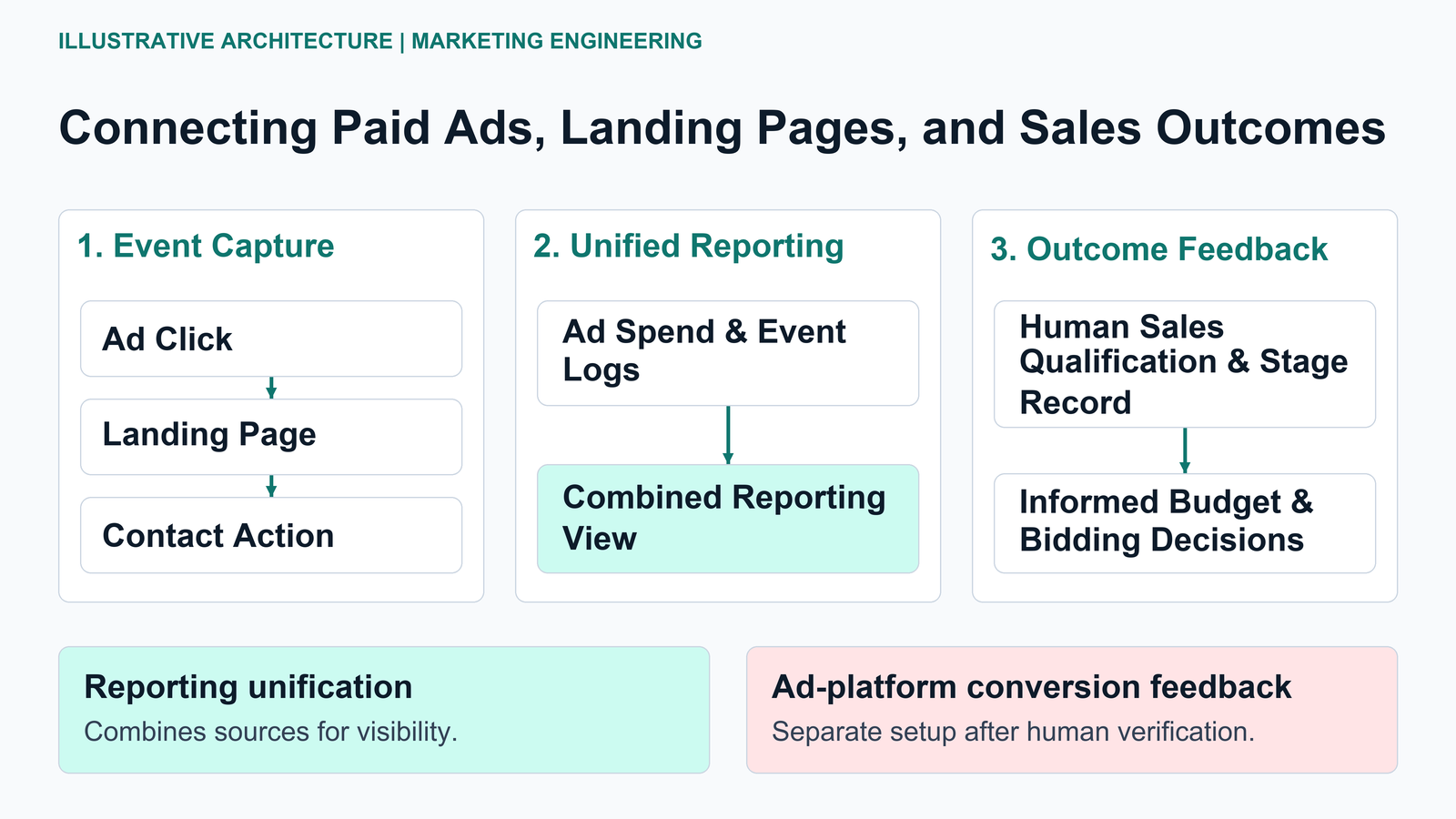
Many teams try to fix bad bidding signals by building nicer charts. They pipe ad spend into a spreadsheet or BI tool and assume conversion tracking is finished. Paid acquisition actually depends on three distinct layers, and building one never completes the others.
Scroll sideways to see every column.
| Layer | What It Captures or Moves | Primary Record Owner | Common Misread Risk |
|---|---|---|---|
| Event Capture | Browser pixels, tag triggers, server events, and micro-conversions like contact_click or form submits on pages and catalogs | Web Engineer & Media Operator | Treating an intent click as a confirmed chat or completed sale |
| Unified Reporting | Automated ingestion of Meta Ads and Google Ads spend and metrics into a central MySQL database and custom dashboard | Marketing Ops / Analytics Lead | Assuming that viewing ad spend beside sales figures trains ad algorithms |
| Outcome Feedback | Configured upload or API sync of verified qualified inquiries or offline orders back into Google Ads or Meta conversion goals | Sales Ops + Media Operator | Uploading unmatched, delayed, or unconsented records without deduplication |
Confusing layer two with layer three is one of the costliest mistakes in campaign management. At Lithe Agency, we engineer reporting pipelines that pull Meta Ads and Google Ads data into a MySQL database and display it in custom dashboards. That gives founders and marketing leads one consistent cross-channel reporting view without manual CSV exports every Monday.
A reporting pipeline, however, is a visibility layer rather than an algorithmic feedback loop. Centralizing Meta and Google metrics inside MySQL does not automatically push offline sales or qualified leads back into Meta Conversions API or Google Offline Conversion Import. Feeding outcomes back into ad algorithms requires a separate setup: capturing deterministic identifiers (GCLID or consented, hashed contact fields), matching them cleanly to downstream sales records, and configuring primary conversion goals carefully.
Handoff Design Across Creative, Landing Pages, and WhatsApp
Repairing this chain does not require ten enterprise software tools. It requires engineering clean handoffs across the three surfaces a buyer touches: ad creative, destination page, and sales conversation.
Creative Hypotheses Before Tagging
Signal quality starts before a visitor ever lands on your site. Broad bait hooks and vague discount angles attract curiosity clicks from people who will never buy, training your pixel on the wrong audience. Pairing measurement cleanup with a structured creative testing framework for ad teams ensures each creative batch tests a specific buyer problem, use case, or price expectation.
Landing Pages and Catalogs as Signal Sources
Routing paid clicks straight to a generic homepage or raw chat link strips away both buyer context and diagnostic events. An engineered landing page or digital product catalog qualifies intent upfront while emitting clean signals at key decision steps. If page conversion stalls first, diagnose UX friction using our breakdown on why your landing page converts at 1 percent.
On Lithe's landing page and catalog builds, we instrument explicit micro-events such as contact_click when visitors tap through to inquire on WhatsApp. Unit discipline is strict here: contact_click measures handoff intent from a specific campaign or product page, never a sent message or paid order. Keeping that definition honest stops media buyers from celebrating button taps when the sales inbox sits empty.
Inquiry-Stage Visibility on WhatsApp
In Indonesia and across Southeast Asia, high-consideration B2B, clinic, education, and catalog deals rarely end in an online cart. Buyers click into WhatsApp, ask about specs or schedules, request a quote, and pay later by transfer. Once conversations enter chat, standard web analytics goes blind and manual admin tallies fall behind.
For Lithe performance marketing clients whose deals continue in chat, conversation visibility can be supported through WAtcher, a WhatsApp inquiry-stage tracker built by our AI implementation partner Agentik AI. Ownership stays clear: Lithe Agency manages paid acquisition, landing pages, and campaign optimization, while Agentik AI provides the inquiry-stage tracking layer when chat visibility is part of the engagement. Stage labels reflect agreed chat milestones such as initial inquiry or quotation requested, and finance still reconciles bank payments before booking revenue.
Buyer Governance Checklist Before Scaling Spend
Before raising ad budgets or hiring a partner to rework tracking, run five governance checks across your team:
- Written qualification rule: Marketing and sales agree in one sentence on what separates a raw chat or form fill from a qualified prospect.
- Primary bidding goal: Google Ads and Meta optimize for verified downstream actions where volume permits, rather than raw page views or unvetted clicks.
- Identifier survival: Click IDs (GCLID, wbraid, fbc) or consented contact details persist from the landing URL into your CRM, chat tracker, or order log.
- Deduplication and timing: Browser and server events share event IDs to prevent double counting, and sales logging finishes inside platform upload windows.
- Account custody: Your business retains admin ownership of ad accounts, tag containers, domain DNS, and reporting tables.
Keep realistic expectations around server-side tagging too: Conversions API setups do not bypass user consent rules, rescue weak offers, or fix six-hour sales reply delays. Because media spend, page instrumentation, creative testing, and tracking maintenance share one acquisition budget, see our companion guide on planning a monthly Google Ads budget beyond ad spend when scoping total investment.
Frequently Asked Questions
Q: Is marketing engineering just another name for hiring an in-house developer for the marketing team?
Not for most operating businesses. While large tech firms hire full-time engineers to build internal tools, most advertisers need clean connections across assets they already run: ad accounts, landing pages, reporting databases, and sales logs. A performance agency with technical implementation capability can set up and maintain that chain without permanent developer headcount.
Q: How does WhatsApp conversion tracking for Google Ads work when buyers refuse to fill out web forms?
Start by separating website handoff events like contact_click from actual chat outcomes instead of removing your WhatsApp button. Capture click identifiers or consented contact details at handoff, track real conversation stages through a CRM or a WhatsApp inquiry-stage tracker like WAtcher from Agentik AI, and import verified stages back into Google Ads on a steady schedule.
Q: If we already have a custom dashboard combining Meta Ads and Google Ads, is our conversion tracking fixed?
Not automatically. A unified dashboard backed by MySQL solves leadership reporting by putting cross-channel spend and campaign metrics in one view. Teaching Meta or Google bidding algorithms which leads became buyers requires a separate outcome-feedback integration into each ad platform.
Q: Should we switch our Google Ads primary goal from form submits to offline qualified leads right away?
Only after checking match rates, monthly volume, and how fast sales logs outcomes. If reps take weeks to update lead status, switching primary goals too early starves automated bidding of timely signals. Validate offline imports as a secondary observation goal first before promoting them to primary optimization.
Q: Does server-side tracking or Meta Conversions API stop spam leads and bots automatically?
No. Server-side tagging improves event delivery when browser cookies drop, so it will faithfully send junk leads if your creative hook, form, or conversion rule lacks qualification filters. Cutting spam requires pairing sharper creative angles and page qualification with downstream sales feedback.
Next Step for Disconnected Campaign Reporting
Scaling media spend on top of disconnected conversion signals only magnifies budget waste. Fixing the gap starts with inspecting what your ad accounts optimize for, what your pages record, and where sales conversations lose track.
Review how Lithe Agency connects campaign management and reporting on our Performance Marketing service page, or see how we build instrumented pages and catalogs on our Landing Page service page. Share your current ad setup, destination URLs, and sales handoff flow to scope the exact measurement fixes your business needs.
Related Resources
Google Ads Monthly Budget Planning: Separating Ad Spend, Management, Landing Pages, and Tracking
Separate your Google Ads monthly budget across five cost layers, calculate acquisition limits from gross margin, and verify pages and tracking before scaling.
Building a Website and WhatsApp Sales Channel Alongside Marketplaces
Build a direct website and opted-in WhatsApp channel alongside your marketplace stores by comparing full selling costs, platform rules, and team capacity.
Understanding ROAS: Beyond the Number
Return on ad spend is more than a dashboard metric. Learn how to interpret ROAS in context: what it reveals about funnel health, creative performance, and budget allocation.