
Building a Website and WhatsApp Sales Channel Alongside Marketplaces
Build a direct website and opted-in WhatsApp channel alongside your marketplace stores by comparing full selling costs, platform rules, and team capacity.
Retail brand owners across Indonesia and Southeast Asia often feel caught between two pressures. Marketplace commission, transaction, and promotional deductions squeeze net margin per order until high sales volume leaves thin returns. Yet sellers who step back from marketplaces to sell via social posts or chat alone often see order volume drop once they lose built-in discovery, while brands running their own ads learn fast that acquiring every shopper yourself is not automatically cheap. Indonesian reporting in May 2026 (Beritasatu, 15 May 2026) described sellers exploring websites, WhatsApp, live commerce, and social channels amid marketplace cost concerns, pointing to a channel-mix decision rather than a marketplace exit.
Direct answer: Build your direct channel as a complementary route for customers acquired through your own marketing, not as a way to divert marketplace orders. Because marketplaces bundle discovery, trust, payment processing, and logistics, compare total selling costs, consent rules, and team capacity before calling a direct channel cheaper.
Why evaluate channel dependence without abandoning marketplaces
Relying entirely on one marketplace exposes a retail brand to sudden fee revisions, algorithm shifts, and side-by-side price wars in search results. Evaluating a direct sales channel for retail brands makes sense when you want clearer visibility into how customers discover your products, ask pre-purchase questions, and come back for repeat orders.
Treating that move as an all-or-nothing exit causes avoidable damage. Pulling stock or budget from an active marketplace store before proving your own acquisition engine cuts order volume much faster than it cuts overhead. Keep your marketplace store running for platform shoppers while building a parallel website and WhatsApp channel for traffic you generate yourself.
What the marketplace currently does for you
Before comparing fee percentages, list the actual jobs a marketplace handles on every order. Platform deductions bundle several operational functions that your own team or vendors have to cover on a direct route:
- Discovery: Category browsing, internal search, and platform promo events bring active shoppers to your product listings.
- Trust: Verified buyer reviews, store ratings, and escrow checkout reassure first-time customers.
- Payments and disputes: Automated payment verification and dispute workflows cut down on manual finance checks.
- Logistics: Integrated courier booking, auto-generated shipping labels, and return routing simplify daily dispatch where offered.
Scroll sideways to see every column.
| Function | Marketplace route | Direct website and WhatsApp route | Evidence to collect |
|---|---|---|---|
| Discovery and trust | Marketplace audience, search visibility, ratings, and verified reviews | Independently acquired traffic from search, social, or ads to a credible website offer | Traffic source logs, page engagement, and customer feedback |
| Payments and protection | Platform checkout facilities, escrow rules, and dispute processes where offered | Chosen payment gateway, order verification, and internal refund policies | Reconciled settlements, gateway fee statements, and refund records |
| Fulfilment and returns | Platform-integrated couriers, shipping labels, and return paths where applicable | Contracted couriers, dispatch tracking, and brand-managed return checks | Courier invoices, dispatch logs, delivery records, and return costs |
| Customer relationship | Communication limited to platform-permitted chat and order updates | Direct contact governed by documented opt-in, privacy notices, and opt-out rules | Consent logs, chat records, order history by ID, and opt-outs |
A permitted, independently acquired website-to-WhatsApp path
A healthy direct channel starts with demand generated outside the marketplace. Never use marketplace chat, product listings, or parcel inserts to steer marketplace shoppers off-platform, and never scrape or import marketplace buyer phone numbers into a WhatsApp broadcast list. Marketplaces enforce strict anti-diversion rules, and breaking them puts your store account at risk while violating messaging consent rules.
Build an independent path from the first click. Shoppers discover your brand through organic content, search, or paid campaigns such as Meta Ads campaigns, then land on a brand-owned website or conversion-focused landing page that clearly lays out product details, pricing, shipping terms, and what to expect in chat.
Your website is an asset you actually control: you set the product presentation, bundle structure, and first-party tracking. WhatsApp is third-party messaging infrastructure governed by Meta policies. Using your website as the front door lets shoppers check prices and specs before messaging your team, so chat stays focused on buyers who genuinely need sizing advice, bundle recommendations, or order support.
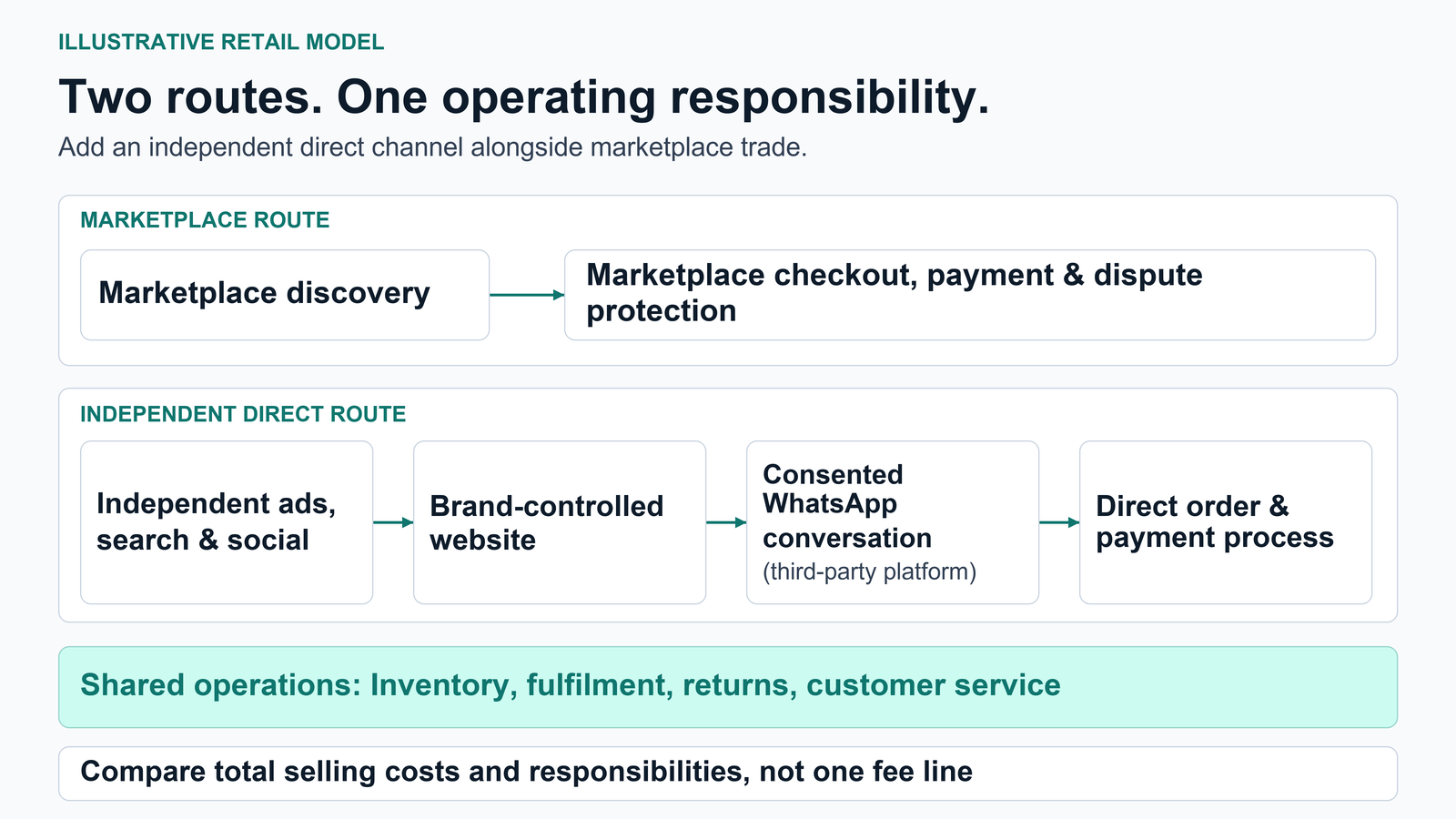
Compare total economics, not one fee line
Skipping a marketplace commission does not make a direct order free. To evaluate a marketplace and WhatsApp channel strategy honestly, compare the full cost stack across both channels over the same period:
- Customer acquisition (CAC) and ads: Paid media spend, creative production, and marketing budgets required to bring shoppers to your website. Looking at ROAS beyond the surface number helps separate top-line ad revenue from real net contribution.
- Product cost and discounts: Cost of goods sold, bundle markdowns, and voucher subsidies.
- Payment gateway fees: Per-transaction processing charges and finance reconciliation time.
- Fulfilment and shipping subsidies: Packaging materials, pick-and-pack labor, courier rates, and any free-shipping subsidies your brand absorbs.
- Returns and refunds: Reverse logistics, restocking time, and damaged-stock write-offs.
- Admin, customer service, and WhatsApp costs: Staff hours answering chats, website hosting, and any WhatsApp Business Platform template, delivered-message, or provider fees if used.
Compare reconciled net sales after refunds against product costs, variable channel expenses, and allocated acquisition spend for a specific buyer cohort, keeping gross and net definitions consistent so discounts and fees are never counted twice. Repeat buyers are not free either, since retention messages, loyalty perks, and chat staffing still carry real costs.
Consent, opt-outs and app-versus-Platform choices
A long-term WhatsApp channel depends on respecting customer permission. A shopper who messages from your website to ask about stock or delivery has started a service chat, not signed up for endless promo blasts. Collect clear opt-in before sending restock alerts or promotional broadcasts, and honour stop or opt-out requests immediately.
It also helps to separate the standard WhatsApp Business app from the WhatsApp Business Platform (API). Smaller retail teams often start on the standard app, which carries no per-message Meta fee but still takes staff hours, phones, and daily supervision. Brands moving to the WhatsApp Business Platform for multi-agent routing, approved templates, or CRM integration pay category- and country-specific delivered-message rates plus provider fees, alongside certain free service reply windows under current rules. Always check official WhatsApp rate cards and your provider's pricing before scaling chat volume.
Run a bounded test and decide from actual orders, costs and workload
Instead of overhauling your entire retail operation at once, run a focused pilot with a fixed budget and staffing cap. Pick one hero product line or bundle, launch a dedicated website offer page, and run controlled independent traffic while leaving your marketplace store untouched. Structuring a multi-platform ad strategy for growing brands helps keep pilot budgets clean without starving your existing campaigns.
Track each step in separate columns: website visits, opted-in WhatsApp chats, confirmed orders, paid orders net of refunds, repeat orders from that cohort, chat staffing hours, and total channel costs. Log lead sources honestly, since a WhatsApp button click only shows where the chat started rather than proving which earlier ad created the demand. Real customer retention shows up in repeat paid orders over time, not in the size of a contact list.
Frequently asked questions
Q: Should a retail brand leave marketplaces once its website and WhatsApp channel are running?
Leaving marketplaces is rarely a smart default because platform search, buyer reviews, and checkout habits continue to bring in steady volume. Most established retail brands build a website and WhatsApp channel alongside their marketplace stores so they are not 100 percent dependent on a single platform.
Q: Is selling through WhatsApp and a brand website cheaper than paying marketplace fees?
A direct channel is not automatically cheaper once you factor in independent ad spend, payment gateway charges, shipping subsidies, returns, chat staffing, and any WhatsApp Business Platform fees. Compare all variable and acquisition costs per net paid order across both routes over the same timeframe before shifting budget.
Q: Can we move existing marketplace customers into our WhatsApp channel?
No. Never use marketplace chat, product listings, order data, or package inserts to divert marketplace orders off-platform or harvest buyer phone numbers. Respect each marketplace's seller rules and build your direct WhatsApp list solely from shoppers acquired through your own channels with clear opt-in permission.
Q: Does a WhatsApp contact list mean our brand fully owns the customer relationship?
A brand-controlled website is an asset you own, whereas WhatsApp remains third-party infrastructure governed by Meta's platform policies, template rules, and message pricing. Repeat business comes from opted-in customer records, verified order history, and a website you control rather than a chat list alone.
Next step: evaluate your direct-channel readiness
If you are weighing whether a direct website-and-WhatsApp channel makes sense alongside your marketplace stores, let's look at the numbers and workflow together. Share what you sell, how customers currently buy from you, and which step needs clearer ownership so we can review how your acquisition campaigns, conversion-focused landing page, and opted-in WhatsApp handoff fit your team.
Operational cost disclaimer: Platform commissions, payment gateway rates, and WhatsApp Business Platform pricing change periodically, so check current official fee schedules when modelling your store economics.
Related Resources
Marketing Engineering for Business: Connecting Ads, Landing Pages, and Sales Signals
Connect ad campaigns, landing page events, and sales qualification logs into one measurement chain so automated bidding optimizes for real buyers.
Google Ads Monthly Budget Planning: Separating Ad Spend, Management, Landing Pages, and Tracking
Separate your Google Ads monthly budget across five cost layers, calculate acquisition limits from gross margin, and verify pages and tracking before scaling.
Understanding ROAS: Beyond the Number
Return on ad spend is more than a dashboard metric. Learn how to interpret ROAS in context: what it reveals about funnel health, creative performance, and budget allocation.