
Manufacturing WhatsApp Enquiries: From RFQ to Quotation Follow-Up
Agree what makes an enquiry quotation-ready before measuring quote volume, and keep specification checks, quotation approval, purchase orders, and payment confirmation separate.
Custom workshops, contract manufacturers, and B2B suppliers regularly run into two bottlenecks in their manufacturing WhatsApp quotation follow-up process. First, a prospect sends a short chat asking for a price list or pastes a request for quotation (RFQ) without dimensions, material grades, quantity tiers, or delivery timing. Estimators cannot calculate an accurate cost from a single line of text, or the conversation goes quiet right after a generic price sheet goes out. Second, once a quotation and minimum order quantity (MOQ) are sent, nobody owns the follow-up. Sales assumes production or engineering is handling technical questions, while production assumes sales is chasing the buyer, leaving the quote sitting in an inbox until a purchase order happens to arrive.
Direct answer: Agree what makes an enquiry quotation-ready before measuring quote volume. Keep specification checks, quotation approval, purchase-order acceptance and payment confirmation as separate decisions with human owners. When each stage records the active quote version, the open buyer decision, and the person responsible for the next check, teams can follow up without guessing.
An enquiry is not a complete RFQ
Counting every inbound WhatsApp chat as a sales opportunity creates immediate friction between marketing, sales, and estimators. In made-to-order manufacturing and industrial supply, a buyer asking for a unit price rarely has a fixed unit until material thickness, tolerances, finishing, packaging, and order volume are pinned down. Treating that first message as a ready-to-price RFQ forces estimators to guess assumptions or send wide price bands.
Buyer silence after receiving a price list or initial quote does not automatically mean your pricing was too high or that sales failed to push. Often, the buyer is waiting on an internal drawing revision, comparing MOQ thresholds against warehouse space, or waiting for purchasing sign-off. Without a clear stage log, your team cannot tell an unworkable spec from a stalled internal review.
What a quotation-ready brief needs
Commercial and technical leads should agree on the minimum inputs required before opening a costing sheet. Standard catalogue items need fewer checks than custom fabrication, while each row below clarifies who verifies the input:
Scroll sideways to see every column.
| Field | Why it matters | Owner and check |
|---|---|---|
| Specification and drawing or revision version | Confirms technical feasibility, material grade, tolerances, and tooling | Engineering or production lead checks if the spec can be made |
| Quantity and MOQ fit | Determines batch setup economics and commercial fit without promising capacity | Sales confirms requested tiers; commercial lead checks MOQ policy |
| Requested delivery timing and destination | Helps assess scheduling and shipping constraints without guaranteeing lead time | Production planner and logistics coordinator check windows |
| Quotation version and validity window | Prevents confusion when raw material prices move or revisions occur | Commercial lead gives sign-off on pricing, version, and validity window |
| Next action and named owner | Stops quotes from sitting unclaimed between sales and engineering | Assigned sales or technical owner logs the open question |
Initial website forms and chat prompts should only ask for non-confidential brief summaries until your team provides a direct channel for sensitive drawings.
Proposed workflow and human approval points
A dependable B2B quotation process relies on clear handoffs between departments rather than expecting one WhatsApp inbox to manage everything. We map the path across six practical stages:
- Inquiry received: A prospect reaches out via WhatsApp, web RFQ form, or direct message.
- Requirements clarified: Sales gathers missing specifications, quantity tiers, and delivery timing, then passes the brief to engineering for a feasibility check.
- Quotation approved and sent: Engineering or production validates feasibility and lead time, and commercial leadership signs off on the formal quote and validity window.
- Buyer review and clarification: The buyer reviews the offer or requests a drawing or quantity revision, looping back for updated pricing under a new quote version.
- Purchase order received and accepted per agreed process: The buyer sends a purchase order, and the commercial team checks that it matches the active quote version, MOQ, and production schedule.
- Payment reconciled: Finance confirms that the deposit or invoice payment has actually cleared in the accounting system.
Not every enquiry moves in a straight line. Your stage log should keep room for awaiting clarification, not proceeding, and unknown so slow-moving B2B deals are not written off too early.
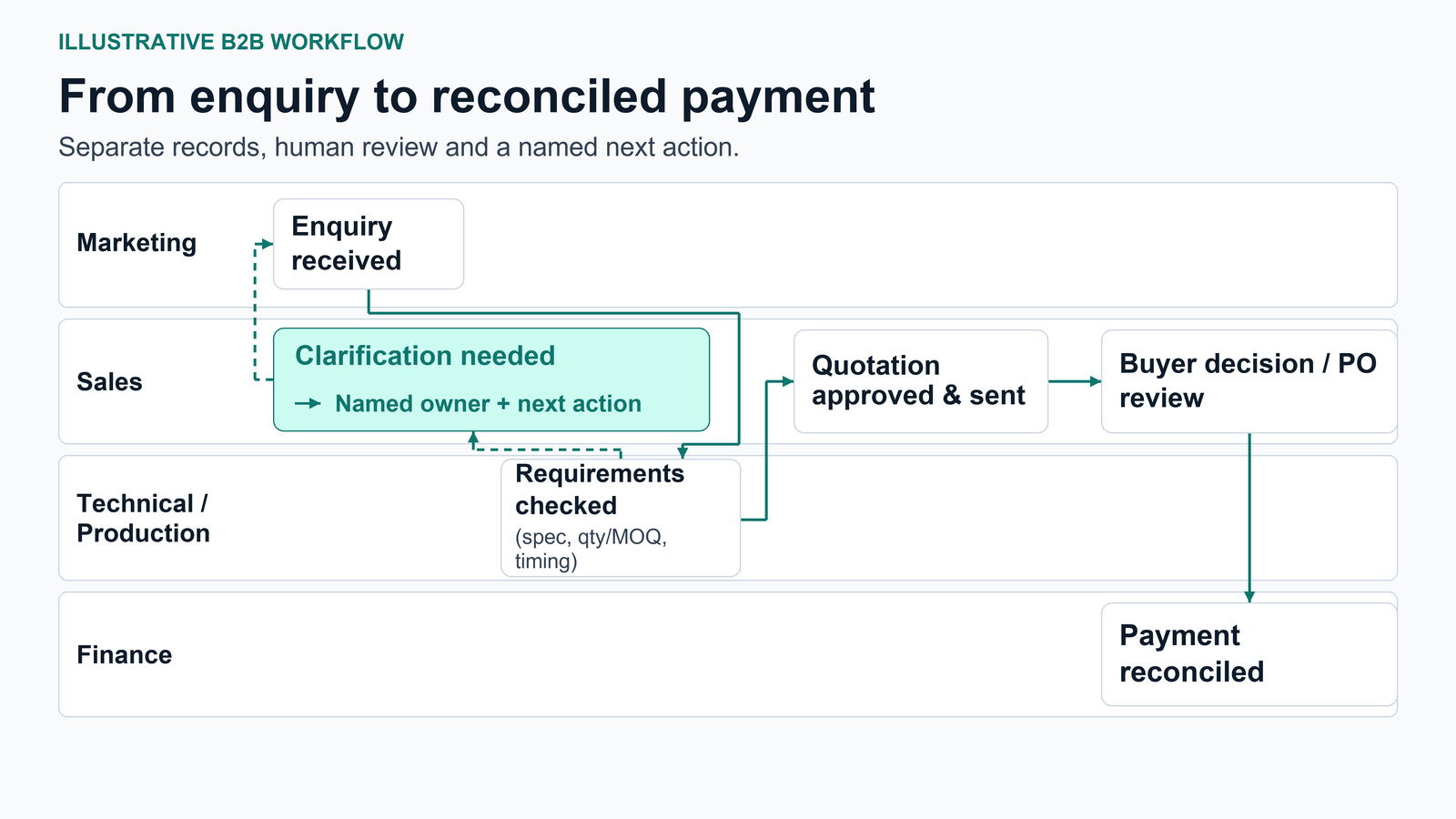
Follow-up should resolve a decision, not repeat a nudge
Generic day-three or day-seven "just checking in" messages rarely move a custom production order forward. Good B2B follow-up focuses on the specific decision holding up the buyer:
- Specification or drawing revision: Ask if the buyer's engineering team needs input on an alternative material grade or tolerance adjustment.
- Quantity or MOQ threshold: Check whether pricing a trial batch or adjusting packaging quantities helps their purchasing team compare options.
- Delivery timing or quotation validity: Let the buyer know when raw material pricing or machine slot availability is coming up for review, without manufacturing fake urgency.
- Internal procurement step: Ask whether their purchasing department needs vendor registration forms, tax documents, or an updated proforma invoice.
Messaging rules also depend on which WhatsApp setup your sales team uses. On the WhatsApp Business Platform, sending a message outside the standard customer-service window requires an approved template and recipient permission, and opt-out requests must be respected right away.
Keep quotations, purchase orders and payment evidence separate
Lumping every late-stage chat into a single "deal won" tag distorts B2B pipeline reporting. A quotation, a purchase order, and a cleared payment are three distinct business records handled by different people.
A quotation is a conditional offer tied to a specific drawing revision, quantity tier, and validity window. A purchase order sent in WhatsApp chat is a buyer commitment to order, not collected revenue or a locked production slot; commercial and production leads still verify that the PO matches the active quote version, unit price, and lead time before accepting it. Finally, payment reconciled sits with finance, which confirms that the deposit or invoice payment has cleared in the bank and accounting log.
Review source uncertainty and the next action with marketing and sales
Connecting your Meta Ads acquisition campaigns and product pages to this stage log changes how marketing and sales judge lead quality. A click on a website WhatsApp button only shows the entrypoint a buyer used that day; it does not prove which earlier search, referral, or campaign started their interest. Lead sources should be logged plainly as known, self-reported, inferred, or unknown.
When teams reconcile lead quality across marketing and sales records, weekly pipeline reviews focus on four practical questions: which specification is still unconfirmed, who owns the next follow-up step, which quote version is active, and whether finance has confirmed payment outside chat tags. In a packaging supplier project alongside our AI partner Agentik AI, we used WAtcher, a WhatsApp inquiry-stage tracker, to map where chats stalled between initial enquiry and quotation so the sales team could review bottlenecks clearly. In custom manufacturing, that same stage visibility still relies on human engineering and finance teams to check feasibility, approve quotes, and reconcile payments.
Frequently asked questions
Q: Is a WhatsApp quote request already a qualified manufacturing lead?
No. A first message asking for pricing is only an initial enquiry until your team checks that the specification, quantity, and delivery timeline match what your shop produces. Agree on the minimum inputs required for a quote-ready brief before counting an enquiry as a qualified opportunity.
Q: Does a purchase order sent in chat mean a confirmed sale or payment?
No. A purchase order shared in a WhatsApp thread does not mean the order has been accepted into production or paid for. Commercial leadership still checks that the PO matches the active quote version and terms, and finance separately confirms when payment clears.
Q: What should the team check when a sent quotation goes quiet?
Look at which decision is still open on the buyer's side. Check whether drawing revisions, MOQ fit, delivery schedules, quote validity, or vendor registration paperwork are waiting on an answer, and confirm whether sales or engineering owns that follow-up call.
Q: Can WhatsApp automation validate technical specifications or send unlimited follow-ups?
No. Automated chat tools cannot judge machining or production feasibility, sign off on custom pricing, or accept purchase orders for your team. And if you use the WhatsApp Business Platform, messages sent outside the customer-service window require an approved template, prior permission, and immediate handling of opt-out requests.
Next step for manufacturing and B2B teams
If your estimators are fielding incomplete WhatsApp chats or your sent quotes keep stalling between sales and engineering, let's look at how your product pages, campaigns, and RFQ handoff fit together. Tell us what you manufacture and where enquiries usually get stuck through our landing page and enquiry structure service (a quick overview of your product line is plenty to start, so no need to attach confidential drawings or pricing sheets).
Related Resources
Marketing Engineering for Business: Connecting Ads, Landing Pages, and Sales Signals
Connect ad campaigns, landing page events, and sales qualification logs into one measurement chain so automated bidding optimizes for real buyers.
Google Ads Monthly Budget Planning: Separating Ad Spend, Management, Landing Pages, and Tracking
Separate your Google Ads monthly budget across five cost layers, calculate acquisition limits from gross margin, and verify pages and tracking before scaling.
Clinic WhatsApp Enquiries: An Administrative Appointment Follow-Up Workflow
Separate incoming WhatsApp messages from your clinic schedule by keeping general enquiries, slot requests, confirmed bookings, and desk check-ins in distinct stages.